Les nombres réels
Ordre et encadrements, topologie de \(\mathbb R\) (intervalles, majorants, bornes sup/inf), valeur absolue et inégalité triangulaire, partie entière, et résolution de systèmes linéaires simples.
1. Résumé de cours détaillé
1.1 Relation d'ordre et inégalités
- On additionne deux inégalités de même sens : \(a\leqslant b,\ c\leqslant d\Rightarrow a+c\leqslant b+d\).
- On multiplie par \(c\geqslant 0\) (sens conservé) ou \(c\leqslant 0\) (sens inversé).
- \(0\leqslant a\leqslant b,\ 0\leqslant c\leqslant d\Rightarrow 0\leqslant ac\leqslant bd\).
- \(0
1.2 Topologie réelle : intervalles, bornes
1.3 Valeur absolue
1.4 Partie entière
1.5 Systèmes linéaires
2. Exercices d'entraînement (créés) avec corrections
La fonction \(g(x)=\dfrac{2x-1}{x+1}\) vérifie \(g'(x)=\dfrac{2(x+1)-(2x-1)}{(x+1)^2}=\dfrac{3}{(x+1)^2}>0\), elle est donc strictement croissante. Sur \([2,3]\), les bornes sont atteintes aux extrémités :
\[ g(2)=\frac{3}{3}=1,\qquad g(3)=\frac{5}{4}. \]Points de changement : \(x=1\) et \(x=3\). On procède par disjonction de cas.
Cas \(x<1\) : \(|x-1|=1-x\), \(|x-3|=3-x\).
\((1-x)+(3-x)=4-2x=4\Rightarrow x=0\). Comme \(0<1\), valide.
Cas \(1\leqslant x\leqslant 3\) : \(|x-1|=x-1\), \(|x-3|=3-x\).
\((x-1)+(3-x)=2=4\) : faux, aucune solution (la somme vaut constamment \(2\) sur \([1,3]\)).
Cas \(x>3\) : \(|x-1|=x-1\), \(|x-3|=x-3\).
\((x-1)+(x-3)=2x-4=4\Rightarrow x=4\). Comme \(4>3\), valide.
Posons \(u_n=\dfrac{n}{n+1}=1-\dfrac{1}{n+1}\). Pour \(n\in\mathbb N\), \(u_n\) est croissante (\(\tfrac1{n+1}\) décroît) et \(u_n<1\).
Minimum : \(u_0=0\), atteint, et c'est le plus petit terme. Donc \(\min A=\inf A=0\).
Supremum : \(u_n<1\) donc \(1\) majore \(A\). Est-ce le plus petit majorant ? Pour tout \(\varepsilon>0\), \(u_n>1-\varepsilon\iff \tfrac1{n+1}<\varepsilon\), vrai pour \(n\) assez grand : aucun majorant \(<1\). Donc \(\sup A=1\), non atteint (pas de maximum).
3. Correction intégrale du TD n°4 — Les nombres réels
Feuille sans corrigé officiel : les 15 exercices sont résolus intégralement, chaque sous-question traitée.
Partie 1 — Encadrer des expressions

(a) \(x+y\)
\([-1,3]+[-5,-4]\) : min \(-1-5=-6\), max \(3-4=-1\).
\(-6\leqslant x+y\leqslant -1\)
(b) \(x-y\)
\(-y\in[4,5]\) : min \(-1+4=3\), max \(3+5=8\).
\(3\leqslant x-y\leqslant 8\)
(c) \(xy\)
\(y<0\) : on teste les 4 coins \((\mp1)(\mp5),\dots\) : \((-1)(-5)=5\), \((3)(-5)=-15\).
\(-15\leqslant xy\leqslant 5\)
(d) \(\dfrac xy\)
\(\tfrac1y\in\left[-\tfrac14,-\tfrac15\right]\). Coins : \((3)\!\cdot\!(-\tfrac14)=-\tfrac34\), \((-1)\!\cdot\!(-\tfrac14)=\tfrac14\).
\(-\tfrac34\leqslant\dfrac xy\leqslant \tfrac14\)
(e) \(\left(\dfrac xy\right)^2\)
\(\tfrac xy\in\left[-\tfrac34,\tfrac14\right]\) contient \(0\) : le carré va de \(0\) à \(\left(\tfrac34\right)^2\).
\(0\leqslant\left(\dfrac xy\right)^2\leqslant \dfrac9{16}\)

(a) \(2x-3y\)
\(2x\in[2,8]\), \(-3y\in[-15,-6]\).
\(-13\leqslant 2x-3y\leqslant 2\)
(b) \(\dfrac1y+3\)
\(\tfrac1y\in\left[\tfrac15,\tfrac12\right]\).
\(\dfrac{16}{5}\leqslant\dfrac1y+3\leqslant \dfrac72\)
(c) \((x-5)(2-y)\)
\(x-5\in[-4,-1]\), \(2-y\in[-3,0]\) (deux facteurs \(\leqslant0\) → produit \(\geqslant0\)) ; max \((-4)(-3)=12\).
\(0\leqslant (x-5)(2-y)\leqslant 12\)
(d) \(\dfrac{x+2}{y-1}\)
\(x+2\in[3,6]\), \(\tfrac1{y-1}\in\left[\tfrac14,1\right]\).
\(\dfrac34\leqslant\dfrac{x+2}{y-1}\leqslant 6\)
(e) \(x^2-4x+4=(x-2)^2\)
\(x-2\in[-1,2]\), le carré va de \(0\) (en \(x=2\)) à \(4\) (en \(x=4\)).
\(0\leqslant x^2-4x+4\leqslant 4\)

(a) \(1 \(a,b>0\), \(\tfrac1b\in\left[\tfrac15,\tfrac12\right]\). Comme \(a>1\) (strict), \(\tfrac ab>\tfrac15\) (non atteint) ; max \(\tfrac72\) (en \(a=7,b=2\)). \(\dfrac15<\dfrac ab\leqslant \dfrac72\) (b) \(-1\leqslant a\leqslant7,\ -2\leqslant b\leqslant5,\ b\neq0\) \(b\) change de signe et peut être arbitrairement proche de \(0\) : \(\tfrac ab\) n'est ni majoré ni minoré. Encadrement impossible (\(\dfrac ab\) non borné). (c) \(1 \(b\to0^+\) rend \(\tfrac ab\to+\infty\) : pas de majorant. Minorant : \(\tfrac ab>\tfrac15\) (comme en (a)). Minoré seulement : \(\dfrac ab>\dfrac15\) (non majoré).
Partie 2 — (In)équations avec racines

(a) \(\sqrt{x-2}=10\)
Domaine \(x\geqslant2\). Carré : \(x-2=100\).
\(x=102\)
(b) \(\sqrt{x-3}+2=9\)
\(\sqrt{x-3}=7\), \(x-3=49\).
\(x=52\)
(c) \(2\sqrt{x+1}+3=1\)
\(\sqrt{x+1}=-1\) : impossible (une racine est \(\geqslant0\)).
\(S=\varnothing\)
(d) \(\sqrt{4x-1}=\sqrt{3-x}\)
Domaine \(\tfrac14\leqslant x\leqslant3\). Carré : \(4x-1=3-x\Rightarrow 5x=4\).
\(x=\tfrac45\)
(e) \(\sqrt{x+12}=\sqrt{x^2+2x-8}\)
Carré : \(x+12=x^2+2x-8\Rightarrow x^2+x-20=0\Rightarrow(x+5)(x-4)=0\). Domaine : \(x^2+2x-8\geqslant0\Rightarrow x\leqslant-4\) ou \(x\geqslant2\), et \(x\geqslant-12\). Les deux candidats \(-5\) et \(4\) conviennent (\(x+12\) et le radicande valent \(7\) et \(16\)).
\(S=\{-5,\ 4\}\)
(f) \(\sqrt{x+4}+\sqrt{x+2}=1\)
Domaine \(x\geqslant-2\). On isole : \(\sqrt{x+4}=1-\sqrt{x+2}\), qui exige \(\sqrt{x+2}\leqslant1\) (\(x\leqslant-1\)). Carré : \(x+4=x+3-2\sqrt{x+2}\Rightarrow\sqrt{x+2}=-\tfrac12\) : impossible.
\(S=\varnothing\)

(a) \(\sqrt{x-3}>2\)
Domaine \(x\geqslant3\), carré : \(x-3>4\).
\(S=\,]7,+\infty[\)
(b) \(\sqrt{2x-5}\leqslant5\)
Domaine \(x\geqslant\tfrac52\), carré : \(2x-5\leqslant25\Rightarrow x\leqslant15\).
\(S=\left[\tfrac52,\ 15\right]\)
(c) \(\sqrt{2+x}\leqslant-1\)
Une racine est \(\geqslant0\), jamais \(\leqslant-1\).
\(S=\varnothing\)
(d) \(\sqrt{x^2-4}\leqslant x-4\)
Il faut \(x-4\geqslant0\) (\(x\geqslant4\)) et \(|x|\geqslant2\). Carré : \(x^2-4\leqslant x^2-8x+16\Rightarrow 8x\leqslant20\Rightarrow x\leqslant\tfrac52\), incompatible avec \(x\geqslant4\).
\(S=\varnothing\)
(e) \(\sqrt{x^2-3x+2}\leqslant x+1\)
Domaine \((x-1)(x-2)\geqslant0\Rightarrow x\leqslant1\) ou \(x\geqslant2\), et \(x+1\geqslant0\ (x\geqslant-1)\). Carré : \(x^2-3x+2\leqslant x^2+2x+1\Rightarrow 5x\geqslant1\Rightarrow x\geqslant\tfrac15\). Intersection :
\(S=\left[\tfrac15,\ 1\right]\cup[2,+\infty[\)
(f) \(\sqrt{2x^2-2}-x\geqslant0\), i.e. \(\sqrt{2x^2-2}\geqslant x\)
Domaine \(x^2\geqslant1\) (\(x\leqslant-1\) ou \(x\geqslant1\)). Si \(x\leqslant-1<0\), l'inégalité est vraie (membre gauche \(\geqslant0>x\)). Si \(x\geqslant1\), carré : \(2x^2-2\geqslant x^2\Rightarrow x^2\geqslant2\Rightarrow x\geqslant\sqrt2\).
\(S=\,]-\infty,-1]\cup[\sqrt2,+\infty[\)

Posons \(BC=a\), donc \(AB=2a\). Pythagore : \(AC^2=AB^2+BC^2=4a^2+a^2=5a^2\), donc \(x=a\sqrt5\), soit \(a=\dfrac{x}{\sqrt5}\).
Périmètre : \(AB+BC+AC=2a+a+x=3a+x=\dfrac{3x}{\sqrt5}+x=x\left(1+\dfrac{3}{\sqrt5}\right)=x\cdot\dfrac{5+3\sqrt5}{5}\).
On résout \(x\cdot\dfrac{5+3\sqrt5}{5}=50\Rightarrow x=\dfrac{250}{5+3\sqrt5}=\dfrac{25(3\sqrt5-5)}{2}\) (après rationalisation).
Partie 3 — Valeur absolue et partie entière

(a) \(|8x-4|=|-2x+3|\)
\(8x-4=\pm(2x-3)\) : \(6x=1\) ou \(10x=7\).
\(S=\left\{\tfrac16,\ \tfrac{7}{10}\right\}\)
(b) \(|x-2|=2|x+1|\)
\(x-2=\pm(2x+2)\) : \(-x=4\) (\(x=-4\)) ou \(3x=0\) (\(x=0\)).
\(S=\{-4,\ 0\}\)
(c) \(|x^2-x+5|=|x-1|\)
\(x^2-x+5>0\) (\(\Delta<0\)) donc \(=|x-1|\) donne \(x^2-x+5=\pm(x-1)\), soit \(x^2-2x+6=0\) ou \(x^2+4=0\) : aucun réel.
\(S=\varnothing\)
(d) \(|x+1|+|1-2x|=9\)
Points \(x=-1\) et \(x=\tfrac12\). Cas \(x<-1\) : \(-3x=9\Rightarrow x=-3\) ✓. Cas \([-1,\tfrac12]\) : \(-x+2=9\Rightarrow x=-7\) ✗. Cas \(x>\tfrac12\) : \(3x=9\Rightarrow x=3\) ✓.
\(S=\{-3,\ 3\}\)
(e) \(|3x-5|\geqslant-2\)
Une valeur absolue est toujours \(\geqslant0\geqslant-2\).
\(S=\mathbb R\)
(f) \(|2x-7|<1\)
\(-1<2x-7<1\Rightarrow 6<2x<8\).
\(S=\,]3,4[\)
(g) \(|x-1|\leqslant|-3x+4|\)
Carré : \((3x-4)^2-(x-1)^2\geqslant0\Rightarrow(2x-3)(4x-5)\geqslant0\).
\(S=\left]-\infty,\tfrac54\right]\cup\left[\tfrac32,+\infty\right[\)
(h) \(|2x-7|>|4x+2|\)
Carré : \((2x-7)^2-(4x+2)^2>0\Rightarrow(2x+9)(6x-5)<0\).
\(S=\left]-\tfrac92,\ \tfrac56\right[\)

(a) Inégalité triangulaire pour \(x+y\) et \(-y\)
\(\big|(x+y)+(-y)\big|\leqslant|x+y|+|-y|\), soit \(|x|\leqslant|x+y|+|y|\), d'où \(|x|-|y|\leqslant|x+y|\).
(b) Pour \(x+y\) et \(-x\)
\(\big|(x+y)+(-x)\big|\leqslant|x+y|+|-x|\), soit \(|y|\leqslant|x+y|+|x|\), d'où \(|y|-|x|\leqslant|x+y|\).
(c) Conclusion
(a) et (b) donnent \(\pm(|x|-|y|)\leqslant|x+y|\), donc \(\big|\,|x|-|y|\,\big|\leqslant|x+y|\). Avec l'inégalité triangulaire usuelle :
\(\big|\,|x|-|y|\,\big|\leqslant|x+y|\leqslant|x|+|y|\). ∎

Pour \(x,y\in\,]-1,1[\), on a \(xy>-1\), donc \(1+xy>0\). L'inégalité \(\left|\dfrac{x+y}{1+xy}\right|<1\) équivaut (dénominateur positif) à \(|x+y|<1+xy\), soit \((x+y)^2<(1+xy)^2\). Or :
\[ (1+xy)^2-(x+y)^2=1+x^2y^2-x^2-y^2=(1-x^2)(1-y^2). \]Comme \(x^2<1\) et \(y^2<1\), les deux facteurs sont \(>0\), donc le produit est \(>0\).

(a) \(\lfloor x\rfloor=3\)
\(\iff 3\leqslant x<4\).
\(S=[3,4[\)
(b) \(2\lfloor x-1\rfloor-3=4\)
\(\lfloor x-1\rfloor=\tfrac72\) : impossible (une partie entière est un entier).
\(S=\varnothing\)
(c) \(-5\left\lfloor-\tfrac17(x-3)\right\rfloor+1=6\)
\(\left\lfloor-\tfrac{x-3}{7}\right\rfloor=-1\iff -1\leqslant-\tfrac{x-3}{7}<0\). En multipliant par \(-7\) (sens inversé) : \(0 \(S=\,]3,\ 10]\)

(a) \(x\leqslant y\Rightarrow\lfloor x\rfloor\leqslant\lfloor y\rfloor\)
\(\lfloor x\rfloor\leqslant x\leqslant y\), et \(\lfloor x\rfloor\in\mathbb Z\). Comme \(\lfloor y\rfloor\) est le plus grand entier \(\leqslant y\), on a \(\lfloor x\rfloor\leqslant\lfloor y\rfloor\).
(b) \(\lfloor x\rfloor+\lfloor y\rfloor\leqslant\lfloor x+y\rfloor\leqslant\lfloor x\rfloor+\lfloor y\rfloor+1\)
Écrivons \(x=\lfloor x\rfloor+\{x\}\), \(y=\lfloor y\rfloor+\{y\}\) avec \(0\leqslant\{x\},\{y\}<1\). Alors \(x+y=\big(\lfloor x\rfloor+\lfloor y\rfloor\big)+(\{x\}+\{y\})\) avec \(0\leqslant\{x\}+\{y\}<2\). Comme \(\lfloor x\rfloor+\lfloor y\rfloor\in\mathbb Z\) :
\[ \lfloor x+y\rfloor=\lfloor x\rfloor+\lfloor y\rfloor+\underbrace{\lfloor\{x\}+\{y\}\rfloor}_{\in\{0,1\}}. \]D'où l'encadrement. ∎
Partie 4 — Topologie réelle

| \(I\) | Intérieur \(\mathring I\) | Fermeture \(\overline I\) |
|---|---|---|
| \(\mathbb R\) | \(\mathbb R\) | \([-\infty,+\infty]\) |
| \(\mathbb R_+=[0,+\infty[\) | \(]0,+\infty[\) | \([0,+\infty]\) |
| \(\mathbb R_-^*=\,]-\infty,0[\) | \(]-\infty,0[\) | \([-\infty,0]\) |
| \([1,2[\) | \(]1,2[\) | \([1,2]\) |
| \([1,2]\) | \(]1,2[\) | \([1,2]\) |
| \(]1,2[\) | \(]1,2[\) | \([1,2]\) |
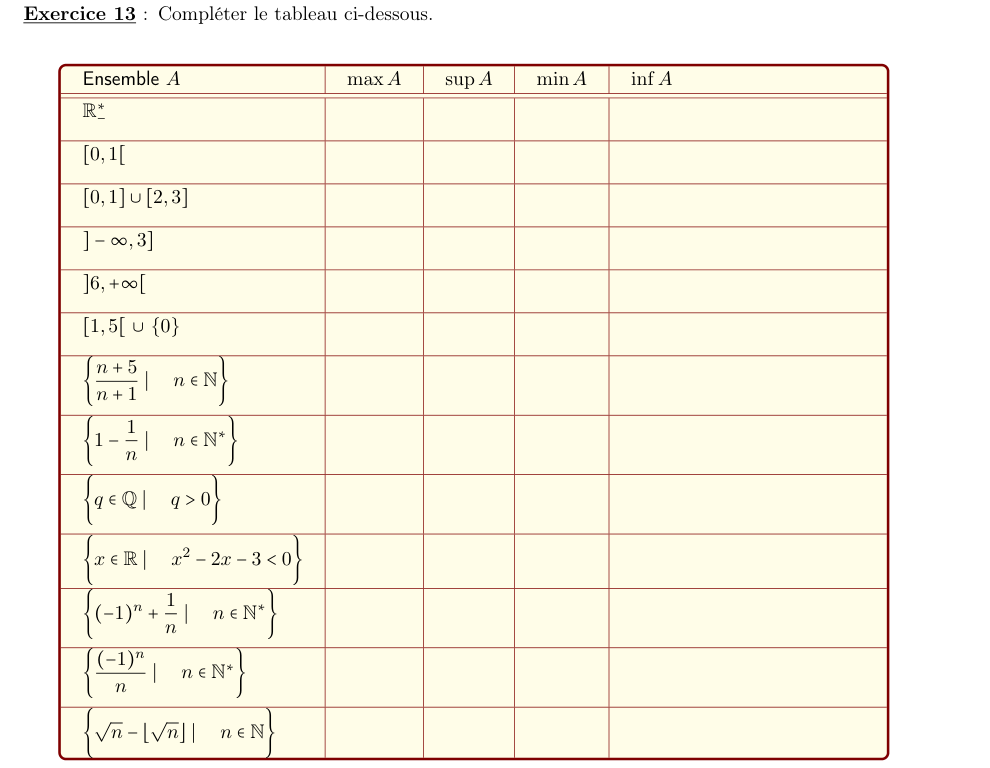
| Ensemble \(A\) | \(\max A\) | \(\sup A\) | \(\min A\) | \(\inf A\) |
|---|---|---|---|---|
| \(\mathbb R_-^*=\,]-\infty,0[\) | — | \(0\) | — | \(-\infty\) |
| \([0,1[\) | — | \(1\) | \(0\) | \(0\) |
| \([0,1]\cup[2,3]\) | \(3\) | \(3\) | \(0\) | \(0\) |
| \(]-\infty,3]\) | \(3\) | \(3\) | — | \(-\infty\) |
| \(]6,+\infty[\) | — | \(+\infty\) | — | \(6\) |
| \([1,5[\cup\{0\}\) | — | \(5\) | \(0\) | \(0\) |
| \(\left\{\tfrac{n+5}{n+1}\mid n\in\mathbb N\right\}\) | \(5\) | \(5\) | — | \(1\) |
| \(\left\{1-\tfrac1n\mid n\in\mathbb N^*\right\}\) | — | \(1\) | \(0\) | \(0\) |
| \(\{q\in\mathbb Q\mid q>0\}\) | — | \(+\infty\) | — | \(0\) |
| \(\{x\mid x^2-2x-3<0\}=\,]-1,3[\) | — | \(3\) | — | \(-1\) |
| \(\left\{(-1)^n+\tfrac1n\mid n\in\mathbb N^*\right\}\) | \(\tfrac32\) | \(\tfrac32\) | — | \(-1\) |
| \(\left\{\tfrac{(-1)^n}{n}\mid n\in\mathbb N^*\right\}\) | \(\tfrac12\) | \(\tfrac12\) | \(-1\) | \(-1\) |
| \(\{\sqrt n-\lfloor\sqrt n\rfloor\mid n\in\mathbb N\}\) | — | \(1\) | \(0\) | \(0\) |
Justifications-clés : \(\tfrac{n+5}{n+1}=1+\tfrac4{n+1}\) décroît de \(5\) (n=0) vers \(1\) (non atteint) ; \((-1)^n+\tfrac1n\) : sous-suite paire décroît vers \(1\) (max \(\tfrac32\) en \(n=2\)), sous-suite impaire croît vers \(-1\) (inf \(-1\) non atteint) ; \(\{\sqrt n\}\) prend \(0\) aux carrés parfaits et s'approche de \(1\) (sup non atteint).
Partie 5 — Systèmes linéaires

(a) \(2x+3y-2z=3\ ;\ x+2y+z=4\ ;\ x-6y+4z=-1\)
De \(L_2\) : \(x=4-2y-z\). Report dans \(L_1\) : \(y+4z=5\) ; dans \(L_3\) : \(8y-3z=5\). On tire \(z=1\), \(y=1\), \(x=1\).
\(S=\{(1,1,1)\}\)
(b) \(x+y-2z=1\ ;\ x+2y+z=4\ ;\ -3x-3y+6z=-1\)
\(L_3=-3(x+y-2z)\), donc \(L_3\) impose \(-3\cdot1=-1\), soit \(-3=-1\) : contradiction.
\(S=\varnothing\) (système incompatible)
(c) \(x-y+z=1\ ;\ 2x-2y+3z=3\ ;\ x-3y+2z=2\)
\(L_2-2L_1\) : \(z=1\). \(L_3-L_1\) : \(-2y+z=1\Rightarrow y=0\). \(L_1\) : \(x=0\).
\(S=\{(0,0,1)\}\)
(d) \(-x+y+z=0\ ;\ 3x+y+3z=-1\ ;\ x+y+2z=-\tfrac12\)
De \(L_1\) : \(y=x-z\). Report : \(L_2\Rightarrow 4x+2z=-1\), \(L_3\Rightarrow 2x+z=-\tfrac12\). La seconde est la moitié de la première (\(-1=-1\)) : système indéterminé. En posant \(x=t\) : \(z=-\tfrac12-2t\), \(y=x-z=3t+\tfrac12\).
\(S=\left\{\left(t,\ 3t+\tfrac12,\ -2t-\tfrac12\right)\ \middle|\ t\in\mathbb R\right\}\) (infinité de solutions)

De (3) : \(B+L=112\). Report dans (2) : \(D+112=192\Rightarrow D=80\). Puis (1) : \(B=D-7=73\), et \(L=112-B=39\).
Vérif : \(80+39+73=192\) ✓ et \(\tfrac{73+39}{2}=56\) ✓.
Chapitre 4 du cours M01 (S1). Sources : Chap_4.pdf (cours magistral) et TD04 — Les nombres réels. Corrigé rédigé intégralement (pas de corrigé officiel fourni).
📂 Documents donnés
Tous les documents originaux liés à ce chapitre (cours magistral, TD, corrigés…). Cliquez pour ouvrir le PDF.
Cours (CM)
TD (énoncé)
Les documents sont inclus dans ce dossier (sous-dossier documents\) — le paquet est autonome et partageable tel quel.