Logique et raisonnements
Le langage de base des mathématiques : propositions, connecteurs, quantificateurs, et surtout les modes de raisonnement (direct, récurrence, contraposition, absurde, analyse-synthèse) qui structurent toutes les démonstrations de l'année.
1. Résumé de cours détaillé
1.1 Propositions, négation, connecteurs
- \(P \text{ et } Q\) (noté \(P\wedge Q\)) est vraie ssi les deux le sont.
- \(P \text{ ou } Q\) (noté \(P\vee Q\)) est vraie ssi au moins l'une l'est.
1.2 Implication, réciproque, équivalence
| \(P\) | \(Q\) | \(\lnot P\) | \(P\wedge Q\) | \(P\vee Q\) | \(P\Rightarrow Q\) | \(P\iff Q\) |
|---|---|---|---|---|---|---|
| V | V | F | V | V | V | V |
| V | F | F | F | V | F | F |
| F | V | V | F | V | V | F |
| F | F | V | F | F | V | V |
1.3 Quantificateurs
- \(\forall x\in E,\ P(x)\) : « pour tout \(x\), \(P(x)\) est vraie ».
- \(\exists x\in E,\ P(x)\) : « il existe (au moins un) \(x\) tel que \(P(x)\) ».
- \(\exists!\,x\in E,\ P(x)\) : « il existe un unique \(x\) tel que \(P(x)\) ».
1.4 Les modes de raisonnement
Ex. \(n\) pair \(\Rightarrow n^2\) pair : \(n=2k \Rightarrow n^2=4k^2=2(2k^2)\).
Ex. \(x+1=3-x \iff 2x=2 \iff x=1\).
Ex. \(\max(x,y)=\dfrac{x+y+|x-y|}{2}\) se prouve en séparant \(x\geqslant y\) et \(x
- Initialisation : \(P(n_0)\) est vraie.
- Hérédité : \(\forall n\geqslant n_0,\ P(n)\Rightarrow P(n+1)\).
Ex. pour « \(n^2\) pair \(\Rightarrow n\) pair », on montre « \(n\) impair \(\Rightarrow n^2\) impair ».
Ex. \(\sqrt2\) irrationnel : supposer \(\sqrt2=p/q\) irréductible mène à \(p\) et \(q\) tous deux pairs.
- Analyse : on suppose qu'une solution existe et on en déduit les conditions nécessaires (candidats possibles).
- Synthèse : on vérifie lesquels de ces candidats sont effectivement solutions.
2. Exercices d'entraînement (créés) avec corrections
Question 1 — Négation.
On retourne chaque quantificateur (\(\forall\to\exists\), \(\exists\to\forall\)) dans l'ordre, et on nie le cœur \(x+y>0\), dont la négation est \(x+y\leqslant 0\) :
Question 2 — Vraie ou fausse ?
\(\mathcal P\) affirme : pour tout réel \(x\), on peut trouver un réel \(y\) avec \(x+y>0\). Fixons un \(x\) quelconque et posons \(y=1-x\) (ce choix dépend légitimement de \(x\) car le \(\exists\) est après le \(\forall\)). Alors \(x+y=x+(1-x)=1>0\). La propriété est donc satisfaite pour tout \(x\).
Posons \(P(n):\ \exists k\in\mathbb N,\ 7^n-1=6k\).
Initialisation (\(n=1\)) : \(7^1-1=6=6\times 1\), donc \(P(1)\) est vraie.
Hérédité : soit \(n\geqslant 1\) tel que \(P(n)\) est vraie, c.-à-d. \(7^n-1=6k\) avec \(k\in\mathbb N\). Alors :
\[ 7^{n+1}-1 = 7\cdot 7^n - 1 = 7\big(7^n-1\big) + 7 - 1 = 7\cdot 6k + 6 = 6\,(7k+1). \]Comme \(7k+1\in\mathbb N\), on a bien \(6\mid 7^{n+1}-1\), donc \(P(n+1)\) est vraie.
Rappel : \(p\) paire signifie \(p(-x)=p(x)\) ; \(i\) impaire signifie \(i(-x)=-i(x)\).
Analyse — on suppose une telle décomposition existe.
Supposons \(f=p+i\) avec \(p\) paire et \(i\) impaire. Pour tout \(x\) :
\[ f(x)=p(x)+i(x), \qquad f(-x)=p(-x)+i(-x)=p(x)-i(x). \]En additionnant puis en soustrayant ces deux égalités, on déduit nécessairement :
\[ p(x)=\frac{f(x)+f(-x)}{2}, \qquad i(x)=\frac{f(x)-f(-x)}{2}. \]Ceci prouve l'unicité : si une décomposition existe, \(p\) et \(i\) sont forcément ces deux fonctions-là.
Synthèse — on vérifie que ces candidats conviennent.
Posons \(p\) et \(i\) par les formules ci-dessus. Alors pour tout \(x\) :
- \(p(-x)=\dfrac{f(-x)+f(x)}{2}=p(x)\) : \(p\) est bien paire.
- \(i(-x)=\dfrac{f(-x)-f(x)}{2}=-\dfrac{f(x)-f(-x)}{2}=-i(x)\) : \(i\) est bien impaire.
- \(p(x)+i(x)=\dfrac{f(x)+f(-x)}{2}+\dfrac{f(x)-f(-x)}{2}=\dfrac{2f(x)}{2}=f(x)\).
3. Correction intégrale du TD n°1 — Logique & Raisonnements
La feuille de TD ne fournit que les énoncés (pas de corrigé officiel) : les 16 exercices sont résolus intégralement ci-dessous, chaque sous-question traitée.
Partie 1 — Nier une proposition
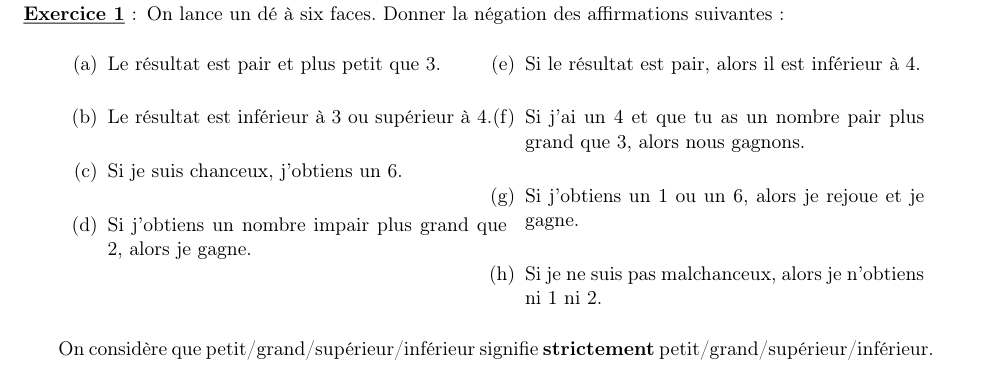
(a) « pair et \(<3\) »
Négation : impair ou \(\geqslant 3\) (« le résultat est impair ou supérieur ou égal à 3 »).
(b) « \(<3\) ou \(>4\) »
Négation : \(\geqslant 3\) et \(\leqslant 4\), soit « le résultat vaut 3 ou 4 ».
(c) « Si je suis chanceux, j'obtiens un 6 »
Forme \(C\Rightarrow 6\). Négation : « je suis chanceux et je n'obtiens pas 6 ».
(d) « Si (impair et \(>2\)) alors je gagne »
Négation : « j'obtiens un nombre impair plus grand que 2 et je ne gagne pas ».
(e) « Si pair, alors \(<4\) »
Négation : « le résultat est pair et supérieur ou égal à 4 ».
(f) « Si (j'ai 4 et tu as pair \(>3\)) alors nous gagnons »
Négation : « j'ai un 4, tu as un nombre pair plus grand que 3, et nous ne gagnons pas ».
(g) « Si (1 ou 6) alors (je rejoue et je gagne) »
La conclusion est une conjonction ; on nie \(A\Rightarrow(B\text{ et }C)\) en \(A\text{ et }(\lnot B\text{ ou }\lnot C)\) :
Négation : « j'obtiens un 1 ou un 6, et (je ne rejoue pas ou je ne gagne pas) ».
(h) « Si (non malchanceux) alors (ni 1 ni 2) »
« ni 1 ni 2 » \(=\) « non 1 et non 2 » ; sa négation est « 1 ou 2 ». D'où :
Négation : « je ne suis pas malchanceux et j'obtiens un 1 ou un 2 ».
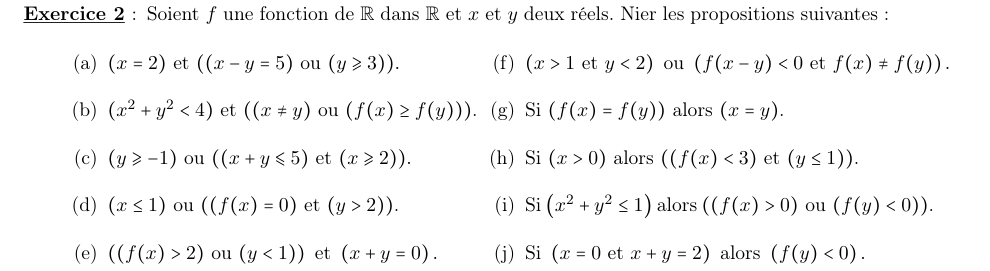
(a) \((x=2)\text{ et }((x-y=5)\text{ ou }(y\geqslant 3))\)
\((x\neq 2)\ \text{ou}\ \big((x-y\neq 5)\text{ et }(y<3)\big)\)
(b) \((x^2+y^2<4)\text{ et }((x\neq y)\text{ ou }(f(x)\geqslant f(y)))\)
\((x^2+y^2\geqslant 4)\ \text{ou}\ \big((x=y)\text{ et }(f(x) (c) \((y\geqslant -1)\text{ ou }((x+y\leqslant 5)\text{ et }(x\geqslant 2))\) \((y<-1)\ \text{et}\ \big((x+y>5)\text{ ou }(x<2)\big)\) (d) \((x\leqslant 1)\text{ ou }((f(x)=0)\text{ et }(y>2))\) \((x>1)\ \text{et}\ \big((f(x)\neq 0)\text{ ou }(y\leqslant 2)\big)\) (e) \(((f(x)>2)\text{ ou }(y<1))\text{ et }(x+y=0)\) \(\big((f(x)\leqslant 2)\text{ et }(y\geqslant 1)\big)\ \text{ou}\ (x+y\neq 0)\) (f) \((x>1\text{ et }y<2)\text{ ou }(f(x-y)<0\text{ et }f(x)\neq f(y))\) \(\big((x\leqslant 1)\text{ ou }(y\geqslant 2)\big)\ \text{et}\ \big((f(x-y)\geqslant 0)\text{ ou }(f(x)=f(y))\big)\) (g) \((f(x)=f(y))\Rightarrow(x=y)\) \((f(x)=f(y))\ \text{et}\ (x\neq y)\) (h) \((x>0)\Rightarrow((f(x)<3)\text{ et }(y\leqslant 1))\) \((x>0)\ \text{et}\ \big((f(x)\geqslant 3)\text{ ou }(y>1)\big)\) (i) \((x^2+y^2\leqslant 1)\Rightarrow((f(x)>0)\text{ ou }(f(y)<0))\) \((x^2+y^2\leqslant 1)\ \text{et}\ (f(x)\leqslant 0)\ \text{et}\ (f(y)\geqslant 0)\) (j) \((x=0\text{ et }x+y=2)\Rightarrow(f(y)<0)\) \((x=0)\ \text{et}\ (x+y=2)\ \text{et}\ (f(y)\geqslant 0)\)
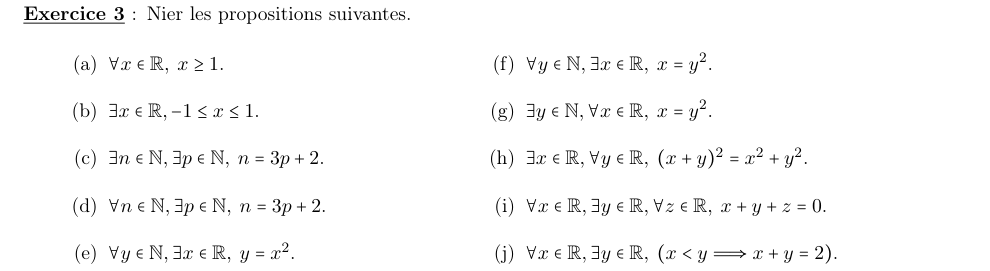
(a) \(\forall x\in\mathbb R,\ x\geqslant 1\)
\(\exists x\in\mathbb R,\ x<1\)
(b) \(\exists x\in\mathbb R,\ -1\leqslant x\leqslant 1\)
Ici \(-1\leqslant x\leqslant 1\) signifie \((x\geqslant -1\text{ et }x\leqslant 1)\), de négation \((x<-1\text{ ou }x>1)\) :
\(\forall x\in\mathbb R,\ (x<-1\ \text{ou}\ x>1)\)
(c) \(\exists n\in\mathbb N,\exists p\in\mathbb N,\ n=3p+2\)
\(\forall n\in\mathbb N,\forall p\in\mathbb N,\ n\neq 3p+2\)
(d) \(\forall n\in\mathbb N,\exists p\in\mathbb N,\ n=3p+2\)
\(\exists n\in\mathbb N,\forall p\in\mathbb N,\ n\neq 3p+2\)
(e) \(\forall y\in\mathbb N,\exists x\in\mathbb R,\ y=x^2\)
\(\exists y\in\mathbb N,\forall x\in\mathbb R,\ y\neq x^2\)
(f) \(\forall y\in\mathbb N,\exists x\in\mathbb R,\ x=y^2\)
\(\exists y\in\mathbb N,\forall x\in\mathbb R,\ x\neq y^2\)
(g) \(\exists y\in\mathbb N,\forall x\in\mathbb R,\ x=y^2\)
\(\forall y\in\mathbb N,\exists x\in\mathbb R,\ x\neq y^2\)
(h) \(\exists x\in\mathbb R,\forall y\in\mathbb R,\ (x+y)^2=x^2+y^2\)
\(\forall x\in\mathbb R,\exists y\in\mathbb R,\ (x+y)^2\neq x^2+y^2\)
(i) \(\forall x\in\mathbb R,\exists y\in\mathbb R,\forall z\in\mathbb R,\ x+y+z=0\)
\(\exists x\in\mathbb R,\forall y\in\mathbb R,\exists z\in\mathbb R,\ x+y+z\neq 0\)
(j) \(\forall x\in\mathbb R,\exists y\in\mathbb R,\ (x La négation d'une implication \(A\Rightarrow B\) est \(A\text{ et }\lnot B\) : \(\exists x\in\mathbb R,\forall y\in\mathbb R,\ (x
Partie 2 — Vrai ou faux ?

Cas (a) : \(x=2,\ y=3,\ f=\mathrm{id}\) (\(f(t)=t\)).
| Prop. | Évaluation | Valeur |
|---|---|---|
| (a) | \(x{=}2\) ✓ ; \(y{=}3\geqslant 3\) ✓ donc \((\text{F ou V})\) ✓ | V |
| (b) | \(x^2{+}y^2{=}13\not<4\) | F |
| (c) | \(y{=}3\geqslant -1\) ✓ | V |
| (d) | \(x{=}2\not\leqslant 1\) ; \(f(x){=}2\neq 0\) : F ou F | F |
| (e) | \(f(x){=}2\not>2\) et \(y{=}3\not<1\) : (F ou F) et … | F |
| (f) | 2ᵉ terme : \(f(-1){=}-1<0\) ✓ et \(2\neq 3\) ✓ | V |
| (g) | \(f(x){=}2\neq f(y){=}3\) : hyp. fausse, \(\text{F}\Rightarrow\) ✓ | V |
| (h) | \(x{>}0\) ✓ mais \(y{=}3\not\leqslant 1\) : \(\text{V}\Rightarrow\text{F}\) | F |
| (i) | \(x^2{+}y^2{=}13\not\leqslant 1\) : \(\text{F}\Rightarrow\) ✓ | V |
| (j) | \(x{=}2\neq 0\) : hyp. fausse, \(\text{F}\Rightarrow\) ✓ | V |
Cas (b) : \(x=y=0,\ f\equiv -1\) (\(f(t)=-1\)).
| Prop. | Évaluation | Valeur |
|---|---|---|
| (a) | \(x{=}0\neq 2\) : F et … | F |
| (b) | \(0<4\) ✓ ; \(f(x){=}f(y){=}-1\) donc \(f(x)\geqslant f(y)\) ✓ | V |
| (c) | \(y{=}0\geqslant -1\) ✓ | V |
| (d) | \(x{=}0\leqslant 1\) ✓ | V |
| (e) | \(y{=}0<1\) ✓ (1ᵉʳ) et \(x{+}y{=}0\) ✓ | V |
| (f) | \(x{=}0\not>1\) (1ᵉʳ F) ; \(f(x){=}f(y)\) (2ᵉ F) | F |
| (g) | \(f(x){=}f(y)\) ✓ et \(x{=}y{=}0\) ✓ : \(\text{V}\Rightarrow\text{V}\) | V |
| (h) | \(x{=}0\not>0\) : hyp. fausse | V |
| (i) | hyp. \(0\leqslant 1\) ✓ ; concl. \(f(y){=}-1<0\) ✓ | V |
| (j) | \(x{+}y{=}0\neq 2\) : hyp. fausse | V |

(a) \(\forall x\in\mathbb R,\ x\geqslant 1\)
Fausse : contre-exemple \(x=0<1\).
(b) \(\exists x\in\mathbb R,\ -1\leqslant x\leqslant 1\)
Vraie : \(x=0\) convient.
(c) \(\exists n,\exists p\in\mathbb N,\ n=3p+2\)
Vraie : \(p=0,\ n=2\) donne \(2=3\cdot 0+2\).
(d) \(\forall n\in\mathbb N,\exists p\in\mathbb N,\ n=3p+2\)
Fausse : pour \(n=0\), il faudrait \(3p+2=0\) avec \(p\in\mathbb N\), impossible.
(e) \(\forall y\in\mathbb N,\exists x\in\mathbb R,\ y=x^2\)
Vraie : tout \(y\in\mathbb N\) est \(\geqslant 0\), donc \(x=\sqrt y\) convient.
(f) \(\forall y\in\mathbb N,\exists x\in\mathbb R,\ x=y^2\)
Vraie : il suffit de prendre \(x=y^2\), qui est un réel.
(g) \(\exists y\in\mathbb N,\forall x\in\mathbb R,\ x=y^2\)
Fausse : un \(y\) fixé donne \(y^2\) fixé, qui ne peut égaler tous les réels \(x\).
(h) \(\exists x\in\mathbb R,\forall y\in\mathbb R,\ (x+y)^2=x^2+y^2\)
\((x+y)^2=x^2+y^2 \iff 2xy=0 \iff xy=0\). Avec \(x=0\), on a \(xy=0\) pour tout \(y\). Vraie (\(x=0\)).
(i) \(\forall x\in\mathbb R,\exists y\in\mathbb R,\forall z\in\mathbb R,\ x+y+z=0\)
Fausse : \(y\) étant fixé après \(x\), l'égalité \(x+y+z=0\) ne peut tenir pour tous les \(z\) (le membre de gauche varie avec \(z\)).
(j) \(\forall x\in\mathbb R,\exists y\in\mathbb R,\ (x Vraie : pour chaque \(x\), prendre \(y=2-x\). Si l'hypothèse \(x
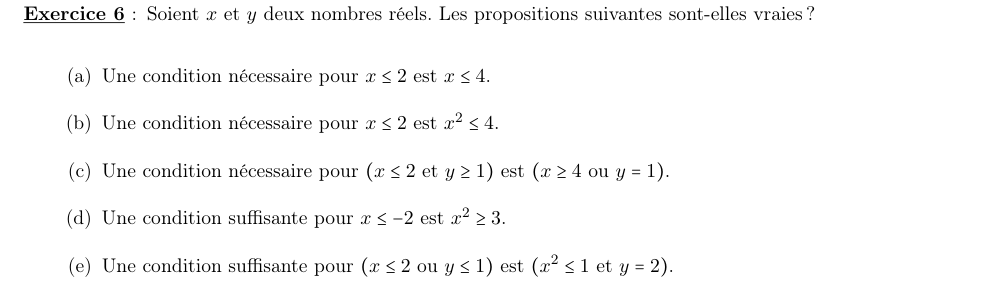
(a) C.N. pour \(x\leqslant 2\) : \(x\leqslant 4\) ?
Il faut \((x\leqslant 2)\Rightarrow(x\leqslant 4)\). Vrai (si \(x\leqslant 2\) alors \(x\leqslant 4\)). Vraie.
(b) C.N. pour \(x\leqslant 2\) : \(x^2\leqslant 4\) ?
Il faut \((x\leqslant 2)\Rightarrow(x^2\leqslant 4)\). Contre-exemple \(x=-5\leqslant 2\) mais \(x^2=25>4\). Fausse.
(c) C.N. pour \((x\leqslant 2\text{ et }y\geqslant 1)\) : \((x\geqslant 4\text{ ou }y=1)\) ?
Contre-exemple \(x=0,\ y=5\) : hypothèse vraie, mais \(x\geqslant 4\) faux et \(y=1\) faux. Fausse.
(d) C.S. pour \(x\leqslant -2\) : \(x^2\geqslant 3\) ?
Il faut \((x^2\geqslant 3)\Rightarrow(x\leqslant -2)\). Contre-exemple \(x=2\) : \(x^2=4\geqslant 3\) mais \(x\leqslant -2\) faux. Fausse.
(e) C.S. pour \((x\leqslant 2\text{ ou }y\leqslant 1)\) : \((x^2\leqslant 1\text{ et }y=2)\) ?
Il faut \((x^2\leqslant 1\text{ et }y=2)\Rightarrow(x\leqslant 2\text{ ou }y\leqslant 1)\). Or \(x^2\leqslant 1\Rightarrow -1\leqslant x\leqslant 1\Rightarrow x\leqslant 2\), donc la conclusion est vraie. Vraie.
Partie 3 — Tables de vérité

(a) \((P\vee Q)\iff(\overline P\wedge\overline Q)\)
Or \(\overline P\wedge\overline Q=\operatorname{non}(P\vee Q)\) : on compare une proposition à sa négation, jamais égales.
| \(P\) | \(Q\) | \(P\vee Q\) | \(\overline P\wedge\overline Q\) | \(\iff\) |
|---|---|---|---|---|
| V | V | V | F | F |
| V | F | V | F | F |
| F | V | V | F | F |
| F | F | F | V | F |
Colonne finale toujours F : c'est une contradiction.
(b) \((P\Rightarrow Q)\vee(\overline R\wedge P)\)
| \(P\) | \(Q\) | \(R\) | \(P\Rightarrow Q\) | \(\overline R\wedge P\) | \(\vee\) |
|---|---|---|---|---|---|
| V | V | V | V | F | V |
| V | V | F | V | V | V |
| V | F | V | F | F | F |
| V | F | F | F | V | V |
| F | V | V | V | F | V |
| F | V | F | V | F | V |
| F | F | V | V | F | V |
| F | F | F | V | F | V |
Fausse uniquement pour \((P,Q,R)=(\text{V},\text{F},\text{V})\).
(c) \((Q\Rightarrow P)\wedge(\overline R\vee P)\)
| \(P\) | \(Q\) | \(R\) | \(Q\Rightarrow P\) | \(\overline R\vee P\) | \(\wedge\) |
|---|---|---|---|---|---|
| V | V | V | V | V | V |
| V | V | F | V | V | V |
| V | F | V | V | V | V |
| V | F | F | V | V | V |
| F | V | V | F | F | F |
| F | V | F | F | V | F |
| F | F | V | V | F | F |
| F | F | F | V | V | V |
Vraie pour VVV, VVF, VFV, VFF et FFF.
(d) \(((P\vee Q)\Rightarrow R)\iff((P\Rightarrow R)\wedge(Q\Rightarrow R))\)
| \(P\) | \(Q\) | \(R\) | \((P{\vee}Q){\Rightarrow}R\) | \((P{\Rightarrow}R){\wedge}(Q{\Rightarrow}R)\) | \(\iff\) |
|---|---|---|---|---|---|
| V | V | V | V | V | V |
| V | V | F | F | F | V |
| V | F | V | V | V | V |
| V | F | F | F | F | V |
| F | V | V | V | V | V |
| F | V | F | F | F | V |
| F | F | V | V | V | V |
| F | F | F | V | V | V |
Colonne finale toujours V : c'est une tautologie (une équivalence toujours vraie).
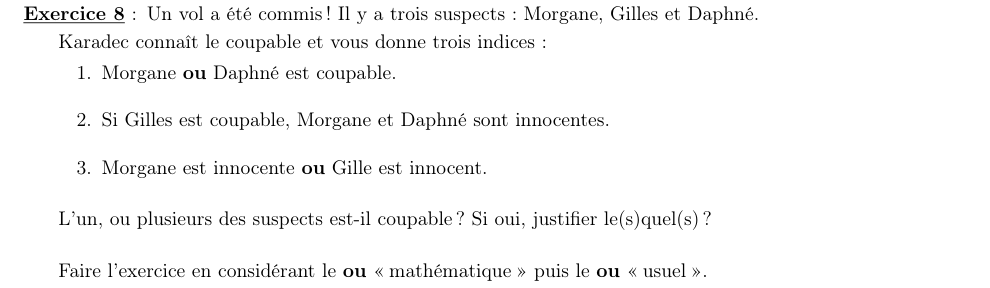
Point commun aux deux lectures : Gilles est innocent.
Supposons \(g\) vrai (Gilles coupable). L'indice (2), \(g\Rightarrow(\lnot m\wedge\lnot d)\), impose \(m\) et \(d\) faux. Mais l'indice (1) exige \(m\vee d\) (au moins l'un des deux coupable) — contradiction. Donc \(g\) est faux : Gilles est innocent dans tous les cas.
Lecture 1 — « ou » mathématique (inclusif).
Avec \(g\) faux, les indices (2) et (3) sont automatiquement satisfaits (\(\lnot g\) vrai). Il ne reste que l'indice (1) : \(m\vee d\). Cela laisse trois possibilités \((m,d)\in\{(\text{V,F}),(\text{F,V}),(\text{V,V})\}\).
Lecture 2 — « ou » usuel (exclusif).
On garde \(g\) faux. L'indice (3) « Morgane innocente ou (exclusif) Gilles innocent » impose qu'exactement une des deux tienne. Comme Gilles est innocent (« Gilles innocent » vrai), « Morgane innocente » doit être faux : Morgane est coupable.
L'indice (1) « Morgane ou (exclusif) Daphné coupable » impose exactement une coupable ; Morgane l'étant, Daphné est innocente. (L'indice (2) reste vérifié car \(g\) est faux.)
Partie 4 — Appliquer les types de raisonnement

(a) \(2x-4=x^2-4\)
\(\iff x^2-2x=0 \iff x(x-2)=0 \iff x=0\) ou \(x=2\).
\(S=\{0,\,2\}\)
(b) \(-3x-1\geqslant x-7\)
\(\iff -3x-x\geqslant -7+1 \iff -4x\geqslant -6\). On divise par \(-4<0\), l'inégalité change de sens : \(x\leqslant \tfrac{6}{4}=\tfrac32\).
\(S=\left]-\infty,\ \tfrac32\right]\)
(c) \(x^2\leqslant -x^4\)
\(\iff x^2+x^4\leqslant 0 \iff x^2(1+x^2)\leqslant 0\). Comme \(1+x^2>0\), il faut \(x^2\leqslant 0\), donc \(x=0\).
\(S=\{0\}\)
(d) \(x^3+x-2=0\)
\(x=1\) est racine évidente (\(1+1-2=0\)). On factorise : \(x^3+x-2=(x-1)(x^2+x+2)\). Le facteur \(x^2+x+2\) a pour discriminant \(\Delta=1-8=-7<0\) : aucune racine réelle.
\(S=\{1\}\)

La fonction \(t\mapsto t^2\) est strictement croissante (donc injective) sur \(\mathbb R_+\) : pour \(a,b\geqslant 0\), on a \(a^2=b^2\iff a=b\). Appliquons-la à \(a=|x|\geqslant 0\) et \(b=|y|\geqslant 0\) :
\[ |x|=|y| \iff |x|^2=|y|^2. \]Or \(|x|^2=x^2\) et \(|y|^2=y^2\) (par définition de la valeur absolue). Donc :
\(x^2=y^2 \iff |x|=|y|\). ∎
Alternative : \(x^2=y^2\iff x^2-y^2=0\iff(x-y)(x+y)=0\iff x=\pm y\iff |x|=|y|\).

Sens \(\Leftarrow\) (trivial).
Si \(x=y\), les deux fractions sont manifestement égales.
Sens \(\Rightarrow\) (par équivalences).
Comme \(x,y\geqslant 0\), on a \(1+x>0\) et \(1+y>0\) : on peut multiplier en croix sans changer le sens :
\[ \frac{x}{1+y}=\frac{y}{1+x} \iff x(1+x)=y(1+y) \iff x+x^2=y+y^2. \]On regroupe :
\[ x^2-y^2+x-y=0 \iff (x-y)(x+y)+(x-y)=0 \iff (x-y)\big(x+y+1\big)=0. \]Comme \(x,y\geqslant 0\), le facteur \(x+y+1\geqslant 1>0\) ne s'annule jamais. Donc \(x-y=0\).
\(x=y\). ∎

(a) \(\dfrac{n(n+1)}{2}\in\mathbb N\).
Parmi deux entiers consécutifs \(n\) et \(n+1\), l'un est pair : leur produit est donc pair, divisible par 2. En détail par disjonction de cas :
- Si \(n=2k\) : \(\dfrac{n(n+1)}{2}=\dfrac{2k(2k+1)}{2}=k(2k+1)\in\mathbb N\).
- Si \(n=2k+1\) : \(\dfrac{n(n+1)}{2}=\dfrac{(2k+1)(2k+2)}{2}=(2k+1)(k+1)\in\mathbb N\).
Dans tous les cas, \(\dfrac{n(n+1)}{2}\in\mathbb N\).
(b) \(\exists k\in\mathbb N,\ n^2=4k\) ou \(n^2=4k+1\).
- Si \(n=2p\) (pair) : \(n^2=4p^2\), donc \(k=p^2\) donne \(n^2=4k\).
- Si \(n=2p+1\) (impair) : \(n^2=4p^2+4p+1=4(p^2+p)+1\), donc \(k=p^2+p\) donne \(n^2=4k+1\).
Un carré parfait est toujours de la forme \(4k\) ou \(4k+1\) (jamais \(4k+2\) ni \(4k+3\)).

Si \(a\) n'est pas divisible par 3, alors son reste dans la division par 3 vaut 1 ou 2 : \(a=3k+1\) ou \(a=3k+2\) avec \(k\in\mathbb Z\). On traite les deux cas.
- \(a=3k+1\) : \(a^2=9k^2+6k+1=3(3k^2+2k)+1\), reste \(1\) : non divisible par 3.
- \(a=3k+2\) : \(a^2=9k^2+12k+4=3(3k^2+4k+1)+1\), reste \(1\) : non divisible par 3.
Dans les deux cas \(a^2\) laisse un reste \(1\) modulo 3, donc \(3\nmid a^2\). ∎

(a) \(1+2+\cdots+n=\dfrac{n(n+1)}{2}\)
Init. \(n=1\) : membre de gauche \(=1\), de droite \(=\tfrac{1\cdot 2}{2}=1\) ✓. Héréd. Supposons \(S_n=\tfrac{n(n+1)}{2}\). Alors :
\[ S_{n+1}=S_n+(n+1)=\frac{n(n+1)}{2}+(n+1)=(n+1)\!\left(\frac n2+1\right)=\frac{(n+1)(n+2)}{2}. \]\(P(n+1)\) vraie, donc la formule vaut pour tout \(n\geqslant 1\).
(b) \(1^2+2^2+\cdots+n^2=\dfrac{n(n+1)(2n+1)}{6}\)
Init. \(n=1\) : \(1=\tfrac{1\cdot 2\cdot 3}{6}=1\) ✓. Héréd. :
\[ S_{n+1}=\frac{n(n+1)(2n+1)}{6}+(n+1)^2=\frac{n+1}{6}\big[n(2n+1)+6(n+1)\big]. \]Or \(n(2n+1)+6(n+1)=2n^2+7n+6=(n+2)(2n+3)\), d'où :
\[ S_{n+1}=\frac{(n+1)(n+2)(2n+3)}{6}=\frac{(n+1)\big((n+1)+1\big)\big(2(n+1)+1\big)}{6}. \]\(P(n+1)\) vraie.
(c) \(1^3+2^3+\cdots+n^3=\dfrac{n^2(n+1)^2}{4}\)
Init. \(n=1\) : \(1=\tfrac{1\cdot 4}{4}=1\) ✓. Héréd. :
\[ S_{n+1}=\frac{n^2(n+1)^2}{4}+(n+1)^3=(n+1)^2\!\left[\frac{n^2}{4}+(n+1)\right]=(n+1)^2\cdot\frac{n^2+4n+4}{4}=\frac{(n+1)^2(n+2)^2}{4}. \]\(P(n+1)\) vraie. (On retrouve \(\sum k^3=(\sum k)^2\).)
(d) \(n\geqslant 4\Rightarrow 2^n\geqslant n^2\)
Init. \(n=4\) : \(2^4=16\geqslant 16=4^2\) ✓. Héréd. Soit \(n\geqslant 4\) tel que \(2^n\geqslant n^2\). Alors :
\[ 2^{n+1}=2\cdot 2^n\geqslant 2n^2. \]Il reste à comparer \(2n^2\) et \((n+1)^2\) : \(2n^2-(n+1)^2=n^2-2n-1=(n-1)^2-2\). Pour \(n\geqslant 4\), \((n-1)^2\geqslant 9>2\), donc \(2n^2\geqslant(n+1)^2\).
\[ 2^{n+1}\geqslant 2n^2\geqslant (n+1)^2. \]\(P(n+1)\) vraie, donc \(2^n\geqslant n^2\) pour tout \(n\geqslant 4\).

(a) \(\sqrt2\) est irrationnel.
Supposons par l'absurde \(\sqrt2\in\mathbb Q\), donc \(\sqrt2=\dfrac pq\) avec \(p,q\in\mathbb N^*\) et la fraction irréductible (\(\gcd(p,q)=1\)). En élevant au carré : \(2=\dfrac{p^2}{q^2}\), soit \(p^2=2q^2\). Ainsi \(p^2\) est pair, donc \(p\) est pair (contraposée de « impair \(\Rightarrow\) carré impair »), \(p=2p'\). Alors \(4p'^2=2q^2\), soit \(q^2=2p'^2\) : \(q^2\) pair, donc \(q\) pair.
\(p\) et \(q\) sont tous deux pairs, ce qui contredit \(\gcd(p,q)=1\). Absurde.
\(\sqrt2\notin\mathbb Q\). ∎
(b) \(\dfrac{\ln 2}{\ln 3}\) est irrationnel.
Le nombre est strictement positif. Supposons par l'absurde \(\dfrac{\ln2}{\ln3}=\dfrac pq\) avec \(p,q\in\mathbb N^*\). Alors \(q\ln2=p\ln3\), soit \(\ln(2^q)=\ln(3^p)\), d'où, l'exponentielle étant injective :
\[ 2^q=3^p. \]Le membre de gauche \(2^q\) est pair (car \(q\geqslant 1\)), tandis que \(3^p\) est impair (produit d'impairs). Un nombre ne peut être à la fois pair et impair : absurde. (Argument équivalent : unicité de la décomposition en facteurs premiers.)
\(\dfrac{\ln2}{\ln3}\notin\mathbb Q\). ∎

(a) \(\sqrt{x(x-3)}=\sqrt{3x-5}\)
Analyse. Supposons \(x\in\mathbb R_+^*\) solution. Les racines exigent \(x(x-3)\geqslant 0\) et \(3x-5\geqslant 0\), i.e. \(x\geqslant\tfrac53\). Les deux membres étant \(\geqslant 0\), on peut élever au carré :
\[ x(x-3)=3x-5 \iff x^2-3x=3x-5 \iff x^2-6x+5=0 \iff (x-1)(x-5)=0. \]Candidats : \(x=1\) ou \(x=5\). La condition \(x\geqslant\tfrac53\) élimine \(x=1\). Reste \(x=5\).
Synthèse. Pour \(x=5\) : \(\sqrt{5\cdot 2}=\sqrt{10}\) et \(\sqrt{15-5}=\sqrt{10}\) ✓.
\(S=\{5\}\)
(b) \(x^{(x^x)}=(x^x)^x\)
Le membre de droite se simplifie : \((x^x)^x=x^{x\cdot x}=x^{x^2}\). L'équation devient \(x^{x^x}=x^{x^2}\).
Analyse. Soit \(x\in\mathbb R_+^*\) solution. On distingue selon la base \(x\) :
- Si \(x=1\) : les deux membres valent \(1\), l'équation est vérifiée.
- Si \(x\neq 1\) : la fonction \(t\mapsto x^{t}\) est injective (base \(>0\) et \(\neq 1\)), donc \(x^{x^x}=x^{x^2}\iff x^x=x^2\). À nouveau par injectivité (base \(x\neq 1\)) : \(x^x=x^2\iff x=2\).
Candidats : \(x=1\) et \(x=2\).
Synthèse.
- \(x=1\) : \(1^{1}=1\) et \((1^1)^1=1\) ✓.
- \(x=2\) : \(x^x=2^2=4\), donc membre de gauche \(2^{4}=16\) ; membre de droite \((2^2)^2=4^2=16\) ✓.
\(S=\{1,\,2\}\)
Chapitre 1 du cours M01 (S1). Sources : Chap_1.pdf (cours magistral) et TD01 — Logique et raisonnement. Corrigé rédigé intégralement (pas de corrigé officiel fourni).
📂 Documents donnés
Tous les documents originaux liés à ce chapitre (cours magistral, TD, corrigés…). Cliquez pour ouvrir le PDF.
Cours (CM)
TD (énoncé)
Les documents sont inclus dans ce dossier (sous-dossier documents\) — le paquet est autonome et partageable tel quel.