Applications
Fonctions entre ensembles : image, antécédent, composition, puis les trois notions centrales — injection, surjection, bijection — avec la bijection réciproque et le calcul des images directes et réciproques.
1. Résumé de cours détaillé
1.1 Application, image, antécédent
1.2 Restriction, prolongement, composition
1.3 Injection, surjection, bijection
- Stricte monotonie sur \(I\subseteq\mathbb R\) \(\Rightarrow\) injective.
- Composées : \(f,g\) inj. \(\Rightarrow g\circ f\) inj. ; \(f,g\) surj. \(\Rightarrow g\circ f\) surj. Si \(g\circ f\) inj. alors \(f\) inj. ; si \(g\circ f\) surj. alors \(g\) surj.
- \(f,g\) bij. \(\Rightarrow g\circ f\) bij. et \((g\circ f)^{-1}=f^{-1}\circ g^{-1}\) (on « inverse dans l'ordre »).
- \((f^{-1})^{-1}=f\).
1.4 Image directe, image réciproque
2. Exercices d'entraînement (créés) avec corrections
Injectivité + surjectivité par résolution de \(y=f(x)\).
Soit \(y\in\mathbb R\). Cherchons les \(x\neq -2\) tels que \(\dfrac{3x+1}{x+2}=y\) :
\[ 3x+1=y(x+2)\iff 3x-yx=2y-1\iff x(3-y)=2y-1\iff x=\frac{2y-1}{3-y}\ \ (y\neq 3). \]Pour \(y\neq 3\), ce \(x\) existe et est unique (donc \(f\) injective et surjective sur son image) ; pour \(y=3\), l'équation \(3x+1=3x+6\) n'a pas de solution. L'image est donc \(J=\mathbb R\setminus\{3\}\) (asymptote horizontale \(y=3\)).
Vérification : \(f^{-1}(3)\) n'existe pas (\(3\notin J\)) et \(f(-2)\) n'existe pas — cohérent.
Union — égalité.
\(y\in f(A\cup B)\iff \exists x\in A\cup B,\ y=f(x)\iff (\exists x\in A,\ y=f(x))\text{ ou }(\exists x\in B,\ y=f(x))\) \(\iff y\in f(A)\text{ ou }y\in f(B)\iff y\in f(A)\cup f(B)\).
Intersection — inclusion seulement.
Soit \(y\in f(A\cap B)\) : \(\exists x\in A\cap B,\ y=f(x)\). Comme \(x\in A\), \(y\in f(A)\) ; comme \(x\in B\), \(y\in f(B)\). Donc \(y\in f(A)\cap f(B)\).
Contre-exemple à l'égalité.
Prenons \(f:\mathbb R\to\mathbb R\), \(f(x)=x^2\), \(A=\mathbb R_-\), \(B=\mathbb R_+\). Alors \(A\cap B=\{0\}\) donc \(f(A\cap B)=\{0\}\), tandis que \(f(A)=f(B)=\mathbb R_+\), d'où \(f(A)\cap f(B)=\mathbb R_+\neq\{0\}\).
Conjecture puis récurrence : \(f^{\circ n}(x)=\dfrac{x}{\sqrt{1+n x^2}}\).
Init. \(n=1\) : \(f^{\circ 1}(x)=\dfrac{x}{\sqrt{1+x^2}}\) ✓.
Héréd. Supposons \(f^{\circ n}(x)=\dfrac{x}{\sqrt{1+nx^2}}\). Posons \(u=f^{\circ n}(x)\). Alors :
\[ 1+u^2=1+\frac{x^2}{1+nx^2}=\frac{1+nx^2+x^2}{1+nx^2}=\frac{1+(n+1)x^2}{1+nx^2}, \] \[ f^{\circ(n+1)}(x)=f(u)=\frac{u}{\sqrt{1+u^2}}=\frac{\dfrac{x}{\sqrt{1+nx^2}}}{\sqrt{\dfrac{1+(n+1)x^2}{1+nx^2}}} =\frac{x}{\sqrt{1+(n+1)x^2}}. \]3. Correction intégrale du TD n°3 — Applications
Feuille sans corrigé officiel : les 14 exercices sont résolus intégralement, chaque sous-question traitée.
Partie 1 — Éléments fondamentaux
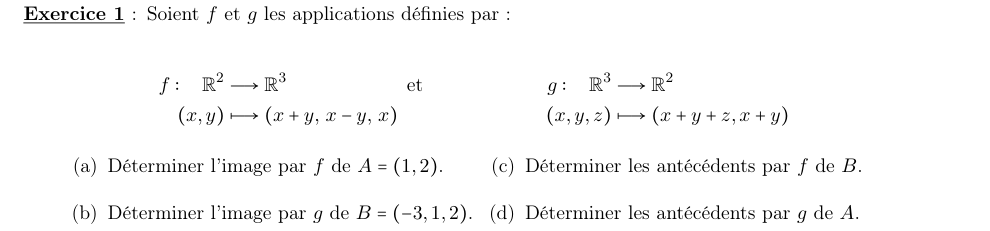
(a) Image de \(A=(1,2)\) par \(f\)
\(f(1,2)=(1+2,\ 1-2,\ 1)=(3,-1,1)\)
(b) Image de \(B=(-3,1,2)\) par \(g\)
\(g(-3,1,2)=(-3+1+2,\ -3+1)=(0,-2)\)
(c) Antécédents de \(B=(-3,1,2)\) par \(f\)
On résout \((x+y,\ x-y,\ x)=(-3,1,2)\). La 3ᵉ composante donne \(x=2\) ; la 1ʳᵉ donne \(y=-3-x=-5\) ; la 2ᵉ imposerait \(x-y=2-(-5)=7=1\), faux.
Aucun antécédent : \(f^{-1}(\{B\})=\varnothing\).
(d) Antécédents de \(A=(1,2)\) par \(g\)
On résout \((x+y+z,\ x+y)=(1,2)\). Par différence \(z=1-2=-1\), et \(x+y=2\) laisse \(x\) libre.
\(\{(x,\ 2-x,\ -1)\mid x\in\mathbb R\}\) (une infinité d'antécédents).

(a) Images de \(A=(1,2)\) et \(B=(2,1)\)
\(f(1,2)=(3,2)\) et \(f(2,1)=(3,2)\). Deux antécédents distincts, même image :
(b) Antécédents de \(C=(1,1)\)
\(x+y=1\) et \(xy=1\) : \(x,y\) sont racines de \(t^2-t+1=0\), de discriminant \(\Delta=1-4=-3<0\). Aucune solution réelle.
Partie 2 — Restriction, prolongement, composée
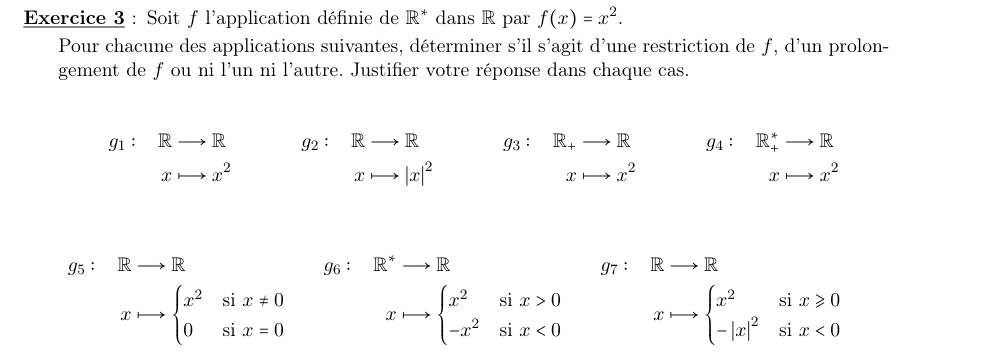
\(g_1:\mathbb R\to\mathbb R,\ x\mapsto x^2\)
Prolongement : domaine \(\mathbb R\supseteq\mathbb R^*\), coïncide (\(x^2\)).
\(g_2:\mathbb R\to\mathbb R,\ x\mapsto |x|^2\)
Prolongement : \(|x|^2=x^2\), même situation que \(g_1\).
\(g_3:\mathbb R_+\to\mathbb R,\ x\mapsto x^2\)
Ni l'un ni l'autre : \(\mathbb R_+=[0,\infty)\) contient \(0\notin\mathbb R^*\) (pas une restriction) et ne contient pas les négatifs (pas un prolongement).
\(g_4:\mathbb R^*_+\to\mathbb R,\ x\mapsto x^2\)
Restriction : \(\mathbb R^*_+\subseteq\mathbb R^*\), même valeur.
\(g_5:\mathbb R\to\mathbb R,\ x\mapsto x^2\) si \(x\neq0\), \(0\) si \(x=0\)
Prolongement : sur \(\mathbb R^*\) vaut \(x^2\) (identique à \(g_1\)).
\(g_6:\mathbb R^*\to\mathbb R,\ x\mapsto x^2\) si \(x>0\), \(-x^2\) si \(x<0\)
Ni l'un ni l'autre : même domaine \(\mathbb R^*\), mais \(g_6(x)=-x^2\neq x^2\) pour \(x<0\) : ce n'est pas \(f\).
\(g_7:\mathbb R\to\mathbb R,\ x\mapsto x^2\) si \(x\geqslant0\), \(-|x|^2\) si \(x<0\)
Ni l'un ni l'autre : pour \(x<0\), \(-|x|^2=-x^2\neq x^2\), donc ne coïncide pas avec \(f\) sur \(\mathbb R^*\) (pas un prolongement).

\(g\circ f:\mathbb R^2\to\mathbb R^2\)
\(g\circ f(x,y)=g(x+y,\ x-y,\ x)=\big((x+y)+(x-y)+x,\ (x+y)+(x-y)\big)\).
\(g\circ f(x,y)=(3x,\ 2x)\)
\(f\circ g:\mathbb R^3\to\mathbb R^3\)
Avec \(a=x+y+z,\ b=x+y\) : \(f\circ g(x,y,z)=f(a,b)=(a+b,\ a-b,\ a)\).
\(f\circ g(x,y,z)=(2x+2y+z,\ z,\ x+y+z)\)

\(f\circ g\)
\(f\circ g(n)=2\,g(n)\) : si \(n\) pair, \(2\cdot\tfrac n2=n\) ; si \(n\) impair, \(2\cdot 0=0\).
\(f\circ g(n)=\begin{cases}n&n\text{ pair}\\0&n\text{ impair}\end{cases}\)
\(g\circ f\)
\(g\circ f(n)=g(2n)\) ; or \(2n\) est toujours pair, donc \(g(2n)=\tfrac{2n}{2}=n\).
\(g\circ f=\operatorname{Id}_{\mathbb N}\)

(a) \(f\circ f(x)\)
\(f(x)+1=\dfrac{x}{x+1}+1=\dfrac{2x+1}{x+1}\), donc \(f\circ f(x)=\dfrac{f(x)}{f(x)+1}=\dfrac{x/(x+1)}{(2x+1)/(x+1)}\).
\(f\circ f(x)=\dfrac{x}{2x+1}\)
(b) \(f\circ f\circ f(x)\)
Avec \(u=\dfrac{x}{2x+1}\) : \(u+1=\dfrac{3x+1}{2x+1}\), d'où \(f(u)=\dfrac{x/(2x+1)}{(3x+1)/(2x+1)}\).
\(f\circ f\circ f(x)=\dfrac{x}{3x+1}\)
(c) \(f^{\circ n}(x)\)
Conjecture \(f^{\circ n}(x)=\dfrac{x}{nx+1}\), démontrée par récurrence : vraie au rang 1 ; si vraie au rang \(n\), avec \(v=\dfrac{x}{nx+1}\), \(v+1=\dfrac{(n+1)x+1}{nx+1}\), donc \(f(v)=\dfrac{x}{(n+1)x+1}\).
\(f^{\circ n}(x)=\dfrac{x}{nx+1}\)
Partie 3 — Injectivité, surjectivité, bijectivité
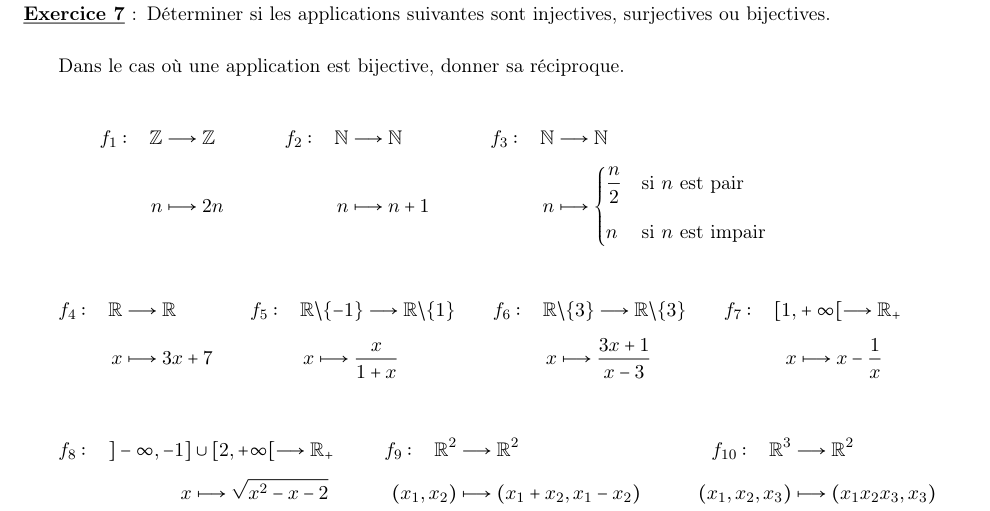
\(f_1:\mathbb Z\to\mathbb Z,\ n\mapsto 2n\)
Injective (\(2n=2m\Rightarrow n=m\)), non surjective (\(1\) n'a pas d'antécédent). Non bijective.
\(f_2:\mathbb N\to\mathbb N,\ n\mapsto n+1\)
Injective, non surjective (\(0\) n'a pas d'antécédent, \(n+1=0\) impossible dans \(\mathbb N\)).
\(f_3:\mathbb N\to\mathbb N,\ n\mapsto \tfrac n2\) si pair, \(n\) si impair
Non injective : \(f_3(1)=1=f_3(2)\). Surjective : tout \(k\) est image de \(2k\) (pair). Non bijective.
\(f_4:\mathbb R\to\mathbb R,\ x\mapsto 3x+7\)
Bijective (affine, pente \(\neq0\)). \(y=3x+7\Rightarrow x=\tfrac{y-7}{3}\).
\(f_4^{-1}(y)=\dfrac{y-7}{3}\)
\(f_5:\mathbb R\setminus\{-1\}\to\mathbb R\setminus\{1\},\ x\mapsto \dfrac{x}{1+x}\)
\(y=\dfrac{x}{1+x}\Rightarrow y+yx=x\Rightarrow x=\dfrac{y}{1-y}\) (défini \(y\neq1\)) : unique. Bijective.
\(f_5^{-1}(y)=\dfrac{y}{1-y}\)
\(f_6:\mathbb R\setminus\{3\}\to\mathbb R\setminus\{3\},\ x\mapsto \dfrac{3x+1}{x-3}\)
\(y=\dfrac{3x+1}{x-3}\Rightarrow x=\dfrac{3y+1}{y-3}\) (défini \(y\neq3\)). Bijective, et \(f_6^{-1}=f_6\) : c'est une involution.
\(f_7:[1,+\infty[\to\mathbb R_+,\ x\mapsto \dfrac{x-1}{x}=1-\tfrac1x\)
Strictement croissante (\(f_7'=\tfrac1{x^2}>0\)) donc injective. Image \([0,1[\neq\mathbb R_+\) : non surjective.
\(f_8:\,]-\infty,-1]\cup[2,+\infty[\to\mathbb R_+,\ x\mapsto\sqrt{x^2-x-2}\)
\(x^2-x-2=(x-2)(x+1)\geqslant0\) sur le domaine. \(y^2=x^2-x-2\Rightarrow x=\dfrac{1\pm\sqrt{9+4y^2}}{2}\) : deux antécédents (un \(\geqslant2\), un \(\leqslant-1\)) pour chaque \(y\geqslant0\). Non injective mais surjective (la branche \(\geqslant2\) atteint tout \(\mathbb R_+\)).
\(f_9:\mathbb R^2\to\mathbb R^2,\ (x_1,x_2)\mapsto(x_1+x_2,\ x_1-x_2)\)
Linéaire, déterminant \(\begin{vmatrix}1&1\\1&-1\end{vmatrix}=-2\neq0\) : bijective. \(y_1=x_1+x_2,\ y_2=x_1-x_2\Rightarrow x_1=\tfrac{y_1+y_2}{2},\ x_2=\tfrac{y_1-y_2}{2}\).
\(f_9^{-1}(y_1,y_2)=\left(\dfrac{y_1+y_2}{2},\ \dfrac{y_1-y_2}{2}\right)\)
\(f_{10}:\mathbb R^3\to\mathbb R^2,\ (x_1,x_2,x_3)\mapsto(x_1x_2x_3,\ x_3)\)
Non injective : \(f_{10}(1,1,0)=(0,0)=f_{10}(2,3,0)\). Non surjective : \((a,0)\) avec \(a\neq0\) exigerait \(x_1x_2x_3=a\neq0\) avec \(x_3=0\), impossible.

\(f_1:\mathbb R\to J,\ x\mapsto 1+e^x\)
\(e^x\in\,]0,+\infty[\) donc \(1+e^x\in\,]1,+\infty[\). \(y=1+e^x\Rightarrow x=\ln(y-1)\).
\(J=\,]1,+\infty[\), \(f_1^{-1}(y)=\ln(y-1)\)
\(f_2:\mathbb R_+\to J,\ x\mapsto -\dfrac x2-1\)
Sur \([0,\infty)\), décroissante de \(-1\) vers \(-\infty\) : image \(]-\infty,-1]\). \(y=-\tfrac x2-1\Rightarrow x=-2(y+1)\).
\(J=\,]-\infty,-1]\), \(f_2^{-1}(y)=-2(y+1)\)
\(f_3:\mathbb R_+\to J,\ x\mapsto \dfrac{1}{1+x^2}\)
Sur \([0,\infty)\) décroissante de \(1\) (en \(0\)) vers \(0\) (exclu) : image \(]0,1]\). \(y=\tfrac1{1+x^2}\Rightarrow x^2=\tfrac{1-y}{y}\Rightarrow x=\sqrt{\tfrac{1-y}{y}}\) (racine \(\geqslant0\)).
\(J=\,]0,1]\), \(f_3^{-1}(y)=\sqrt{\dfrac{1-y}{y}}\)
\(f_4:\mathbb R_+\to J,\ x\mapsto x+x^2\)
Sur \([0,\infty)\) croissante de \(0\) vers \(+\infty\) : image \([0,+\infty[\). \(y=x^2+x\Rightarrow x=\dfrac{-1+\sqrt{1+4y}}{2}\) (racine positive).
\(J=[0,+\infty[\), \(f_4^{-1}(y)=\dfrac{-1+\sqrt{1+4y}}{2}\)

(a) Si \(f\) ou \(g\) injective, alors \(h\) injective.
Supposons \(f\) injective. Soit \((x,x')\) avec \(h(x)=h(x')\), i.e. \((f(x),g(x))=(f(x'),g(x'))\). En particulier \(f(x)=f(x')\), donc \(x=x'\) par injectivité de \(f\). (Idem si \(g\) injective.)
(b) \(f,g\) surjectives \(\Rightarrow h\) surjective ?
Non en général. Contre-exemple : \(E=\mathbb R,\ f=g=\operatorname{Id}_{\mathbb R}\) (surjectives). Alors \(h(x)=(x,x)\), d'image la diagonale \(\{(t,t)\mid t\in\mathbb R\}\subsetneq\mathbb R^2\). Par exemple \((0,1)\) n'a pas d'antécédent.
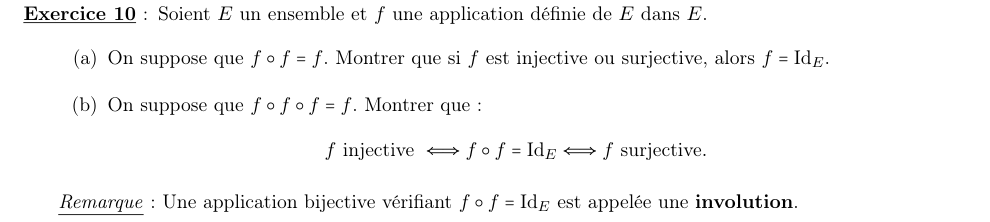
(a) \(f\circ f=f\) : montrer que \(f\) injective ou surjective \(\Rightarrow f=\operatorname{Id}_E\).
Si \(f\) injective : de \(f(f(x))=f(x)\), l'injectivité donne \(f(x)=x\) pour tout \(x\).
Si \(f\) surjective : soit \(y\in E\) ; \(\exists x,\ f(x)=y\). Alors \(f(y)=f(f(x))=f(x)=y\). Tout \(y\) étant atteint, \(f(y)=y\) partout.
(b) \(f\circ f\circ f=f\) : montrer \(f\) inj. \(\iff f\circ f=\operatorname{Id}_E\iff f\) surj.
\(f\) inj. \(\Rightarrow f\circ f=\operatorname{Id}\) : de \(f(f(f(x)))=f(x)\), l'injectivité donne \(f(f(x))=x\).
\(f\circ f=\operatorname{Id}\Rightarrow f\) surj. : tout \(y=f(f(y))\) a pour antécédent \(f(y)\).
\(f\) surj. \(\Rightarrow f\circ f=\operatorname{Id}\) : soit \(x\) ; \(\exists a,\ x=f(a)\). Alors \(f(f(x))=f(f(f(a)))=f(a)=x\) (car \(f^{\circ3}=f\)).
\(f\circ f=\operatorname{Id}\Rightarrow f\) inj. : \(f(x)=f(x')\Rightarrow f(f(x))=f(f(x'))\Rightarrow x=x'\).
Partie 4 — Images directes et réciproques

(a) Image directe par \(f\) de \(\{0\}\)
\(f(\{0\})=\{e^0\}=\{1\}\)
(b) Image directe par \(g\) de \(\mathbb R_-\)
Pour \(x\leqslant0\), \(|x|=-x\) parcourt \([0,\infty)\), donc \(\sqrt{|x|}\) parcourt \([0,\infty)\).
\(g(\mathbb R_-)=\mathbb R_+\)
(c) Image réciproque de \([1,2[\) par \(f\)
\(e^x\in[1,2[\iff 0\leqslant x<\ln2\).
\(f^{-1}([1,2[)=[0,\ln2[\)
(d) Image réciproque de \([0,1[\) par \(g\)
\(\sqrt{|x|}\in[0,1[\iff |x|<1\).
\(g^{-1}([0,1[)=\,]-1,1[\)

(a) \(f(\mathbb R)\)
\([-1,1]\)
(b) \(f([0,\pi])\)
\(\cos\) décroît de \(1\) à \(-1\).
\([-1,1]\)
(c) \(f\!\left([-\tfrac\pi2,\tfrac\pi2]\right)\)
\(\cos\geqslant0\), maximum \(1\) en \(0\), minimum \(0\) en \(\pm\tfrac\pi2\).
\([0,1]\)
(d) \(f\!\left([\tfrac{5\pi}4,\tfrac{7\pi}4]\right)\)
Sur \([\pi,2\pi]\), \(\cos\) est croissant : de \(\cos\tfrac{5\pi}4=-\tfrac{\sqrt2}2\) à \(\cos\tfrac{7\pi}4=\tfrac{\sqrt2}2\).
\(\left[-\dfrac{\sqrt2}2,\ \dfrac{\sqrt2}2\right]\)
(e) \(f^{-1}\!\left(\left\{\tfrac{\sqrt3}2\right\}\right)\)
\(\cos x=\tfrac{\sqrt3}2\iff x=\pm\tfrac\pi6+2k\pi\).
\(\left\{\pm\dfrac\pi6+2k\pi\ \middle|\ k\in\mathbb Z\right\}\)
(f) \(f^{-1}([0,1])\)
\(\cos x\geqslant0\) sur les intervalles centrés sur les multiples de \(2\pi\) :
\(\displaystyle\bigcup_{k\in\mathbb Z}\left[-\tfrac\pi2+2k\pi,\ \tfrac\pi2+2k\pi\right]\)
(g) \(f^{-1}\!\left(f\!\left([0,\tfrac\pi2]\right)\right)\)
\(f([0,\tfrac\pi2])=[0,1]\), donc c'est \(f^{-1}([0,1])\), identique à (f).
\(\displaystyle\bigcup_{k\in\mathbb Z}\left[-\tfrac\pi2+2k\pi,\ \tfrac\pi2+2k\pi\right]\)
(h) \(f\!\left(f^{-1}([0,1])\right)\)
\(f(f^{-1}(J))=J\cap f(\mathbb R)=[0,1]\cap[-1,1]\).
\([0,1]\)

(a) Ensemble d'arrivée pour bijectivité + \(f^{-1}\)
\(y=\dfrac{3x+1}{x+1}\Rightarrow y(x+1)=3x+1\Rightarrow x(y-3)=1-y\Rightarrow x=\dfrac{1-y}{y-3}\) (défini \(y\neq3\)).
\(f:\mathbb R\setminus\{-1\}\to\mathbb R\setminus\{3\}\) bijective, \(f^{-1}(y)=\dfrac{1-y}{y-3}\).
(b) \(f(]0,1[)\) et \(f([2,3])\)
\(f'(x)=\dfrac{3(x+1)-(3x+1)}{(x+1)^2}=\dfrac{2}{(x+1)^2}>0\) : \(f\) strictement croissante. \(f(0)=1,\ f(1)=2\) ; \(f(2)=\tfrac73,\ f(3)=\tfrac52\).
\(f(]0,1[)=\,]1,2[\) ; \(f([2,3])=\left[\tfrac73,\ \tfrac52\right]\)
(c) \(f^{-1}(]0,1[)\) et \(f^{-1}(]1,2[)\)
\(f\) croissante : \(f(x)=0\Rightarrow x=-\tfrac13\), \(f(x)=1\Rightarrow x=0\), \(f(x)=2\Rightarrow x=1\).
\(f^{-1}(]0,1[)=\left]-\tfrac13,\ 0\right[\) ; \(f^{-1}(]1,2[)=\,]0,1[\)

(a) \(f\) est bijective
\(f\) est linéaire de matrice \(\begin{pmatrix}1&-4\\2&3\end{pmatrix}\), de déterminant \(1\cdot3-(-4)\cdot2=3+8=11\neq0\). Donc \(f\) est bijective.
(b) \(f(\Delta)\) avec \(\Delta=\{(x,y)\mid x+2y=1\}\)
On paramètre \(\Delta\) par \(x=1-2y\), \(y\in\mathbb R\). Alors :
\[ f(1-2y,\ y)=\big((1-2y)-4y,\ 2(1-2y)+3y\big)=(1-6y,\ 2-y). \]Posons \(X=1-6y,\ Y=2-y\). De \(Y\) : \(y=2-Y\), d'où \(X=1-6(2-Y)=6Y-11\), soit \(X-6Y=-11\).
Chapitre 3 du cours M01 (S1). Sources : Chap_3.pdf (cours magistral) et TD03 — Applications. Corrigé rédigé intégralement (pas de corrigé officiel fourni).
📂 Documents donnés
Tous les documents originaux liés à ce chapitre (cours magistral, TD, corrigés…). Cliquez pour ouvrir le PDF.
Cours (CM)
TD (énoncé)
Les documents sont inclus dans ce dossier (sous-dossier documents\) — le paquet est autonome et partageable tel quel.